
Mammals of Simien Mountains National Park
The combination of altitudinal variation and isolation of the Simien Mountains has given rise to a number of rare and endemic species and a high level of diversity. This high endemicity and diversity justifies the inclusion of SMNP in Conservation International’s Eastern Afromontane Biodiversity Hotspot. The remoteness and isolation of the area that determine this endemism has also rendered these isolated populations of species such as the Ethiopian wolf, walia ibex or gelada to be more vulnerable to local extirpation or extinction from many threats.
The following are some of the large and/or commonly seen mammals found in SMNP
| Common Name | Scientific Name |
|---|---|
| Olive baboon | Papio anubis |
| Hamadryas baboon | Papio hamadryas |
| Vervet monkey | Ceropithecus aethiops |
| Colobus monkey | Colobus guereza |
| Gelada* | Theropithecus gelada |
| Rock hyrax | Procavia capensis |
| Menelik’s bushbuck* | Tragelaphus seriptue menelik |
| Klipspringer | Oreotragus oreotragus |
| Grey duiker | Sylvicapra grimmia |
| Walia ibex* | Capra ibex walie |
| Golden (common) jackal | Canis aureus |
| Ethiopian wolf* | Canis simensis |
| Spotted hyena | Crocuta crocuta |
| Serval | Felis serval |
| Leopard Caracal | Panthera pardus Felis caracal |
The Ethiopian Wolf, Gelada and Walia Ibex are three of the many feature species that are sure to be highlights of your visit to the Simien Mountains National Park:
Ethiopian Wolf (Canis simensis)
Local Name: Ky Kebero
The Ethiopian wolf is the rarest canid in the world, and Africa’s most threatened carnivore. The closest living relatives of the Ethiopian wolf are grey wolves and coyotes. The Ethiopian wolf ancestor crossed over from Eurasia during the Pleistocene period less than 100,000 years ago, when sea levels were lower and Africa and the Middle East were connected. At the time, the highlands of Ethiopia were predominately Afroalpine grasslands and heathlands, and these habitats were ideal for many small mammals, particularly grass rats and molerats. This Afroalpine environment and its abundant rodents drove the Ethiopian wolf evolution morphologically into a specialized rodent hunter with an elongated muzzle, long legs and a distinctive reddish coat, with white markings and a darker tail tip. Male Ethiopian wolves weigh between 14 and 20kg, while the weight of adult females ranges from 11 to 16 kg.
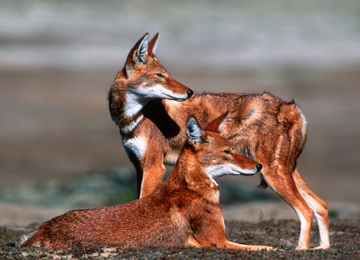
Local Name: Ky Kebero
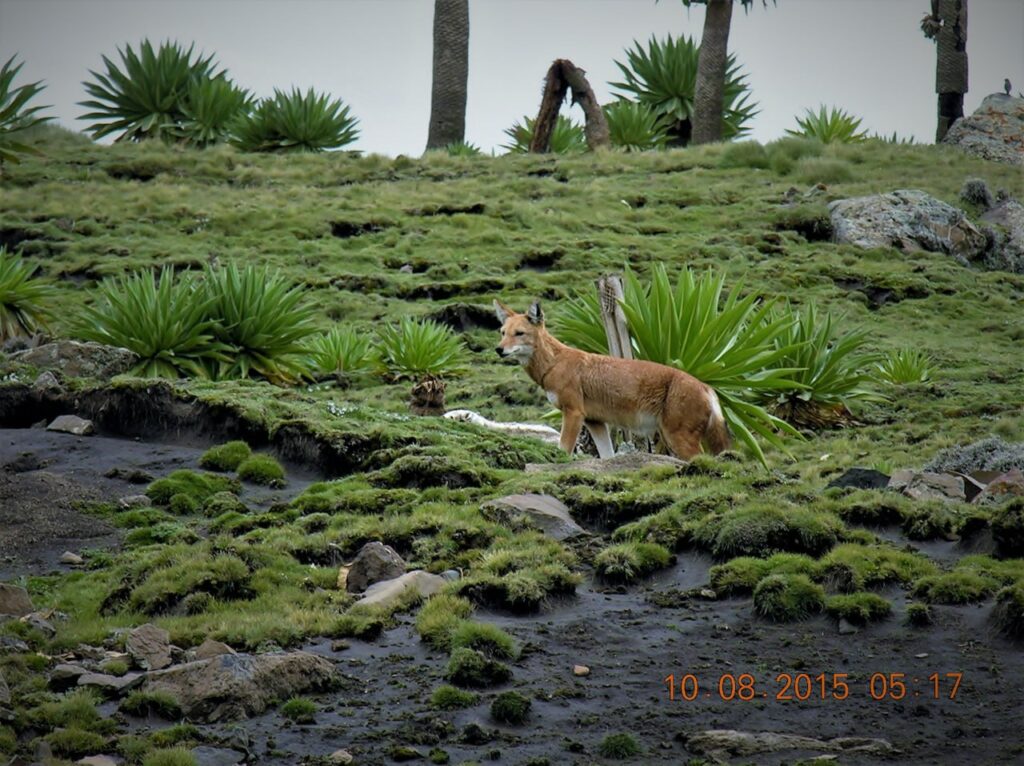
By: Maru B.
Ethiopian wolves live in packs of between 2 and 18 animals, which share and defend an exclusive territory. Unlike most social carnivores, Ethiopian wolves forage and feed alone during the day. In Simien they are mostly visible foraging or walking early in the morning and late in the afternoon, and occasionally in small groups, greeting or scent marking along their territory boundaries. Dens are only used during the short breeding season by pups and nursing females. The rest of the pack sleeps in the open but helps protect the den from predators and contributes food to the pups.
The Ethiopian wolf is restricted to just six isolated mountain top areas of the Ethiopian highlands. With a total world population of between 400 to 520 individuals, it is highly endangered. As a result it is legally protected in the country from any activities that may threaten its survival. Rapidly expanding cattle and crop farming are severe threats, as well as diseases such as rabies and canine distemper transmitted from domestic dogs.
In SMNP, Ethiopian wolves are found above the limit of agriculture and they are somewhat nocturnal and alert to the presence of people. That said, visitors keeping a keen eye in the core wolf areas of the park during the early morning and late afternoon are likely to be rewarded by a sighting of these handsome and rare carnivores.
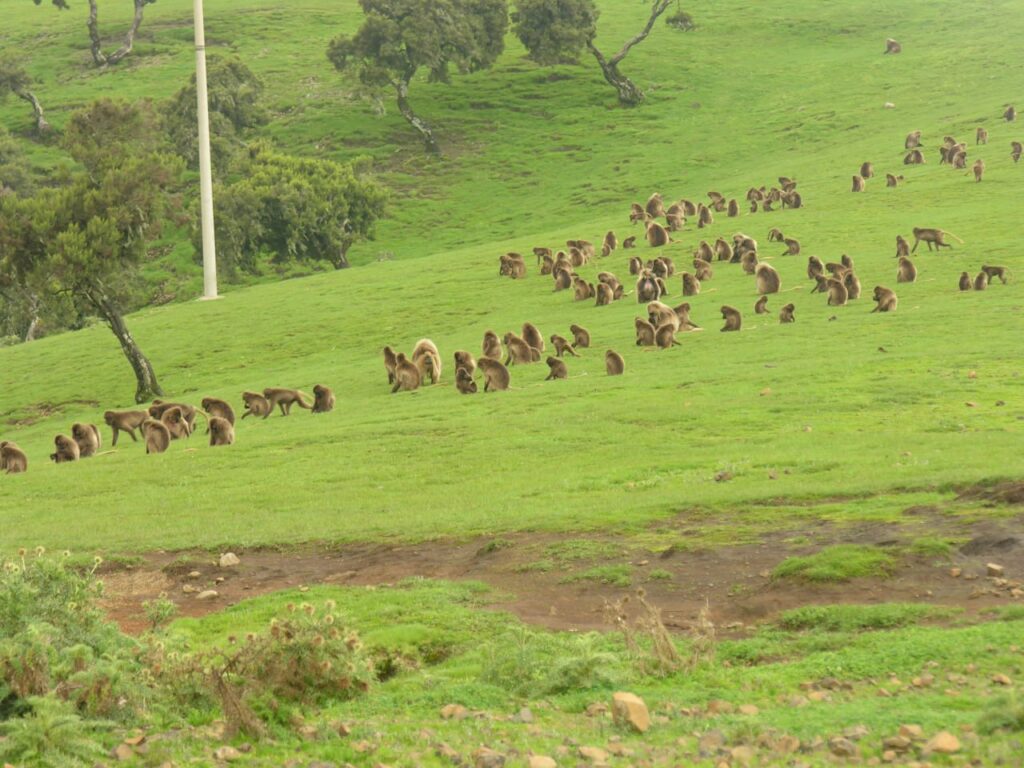
Gelada (Theropithecus gelada)
The Bleeding Heart Local name: Chilada
The gelada is an Old World monkey, not a baboon despite previous naming conventions. It is the only living member of the once widespread genus Theropithecus and is only found in the highlands of Ethiopia. The present day distribution of the gelada is limited to the steep escarpments and gorges that border the eastern side of the central highlands and the northwestern highlands of Ethiopia. The gelada feeds predominantly on fresh shoots of grass, and to a lesser extent on grass roots and seeds. The gelada is also called the bleeding heart baboon as a result of the distinctive, bright red, heart-shaped patch on its chest. The gelada social system consists of a hierarchy of social groupings. The basic group is a reproductive unit of the breeding males (1-4) and females (1-10) and their dependent young.
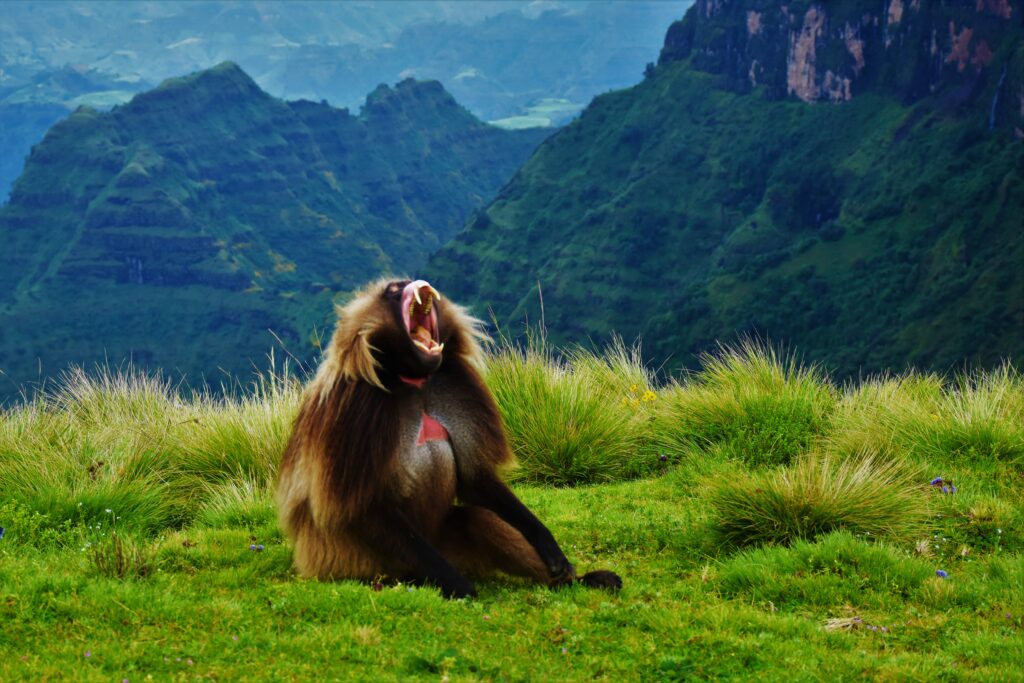
The females tend to be closely related and have strong social ties and stay in their band all their lives. A band of gelada shares a common foraging and sleeping area and may contain 2-10 reproductive units, as well as 1-3 all male groups (non-breeding males of a young age, who remain in these groups for 2-4 years before trying to enter a reproductive unit). The ranging areas of different bands overlap, and can mix easily for a short period, without any aggression, to form very large gelada ‘communities’ or herds. These herds can be up to 1,000 strong – geladas can associate in one of the largest groups of any primate on earth.
It is estimated that approximately 20000 geladas live in the park with a further 5,000 on the surrounding Simien massif. The average band size is 200 geladas. There is a higher density of geladas in Sankaber and a lower density towards the cliffs of Gich and Chennek.
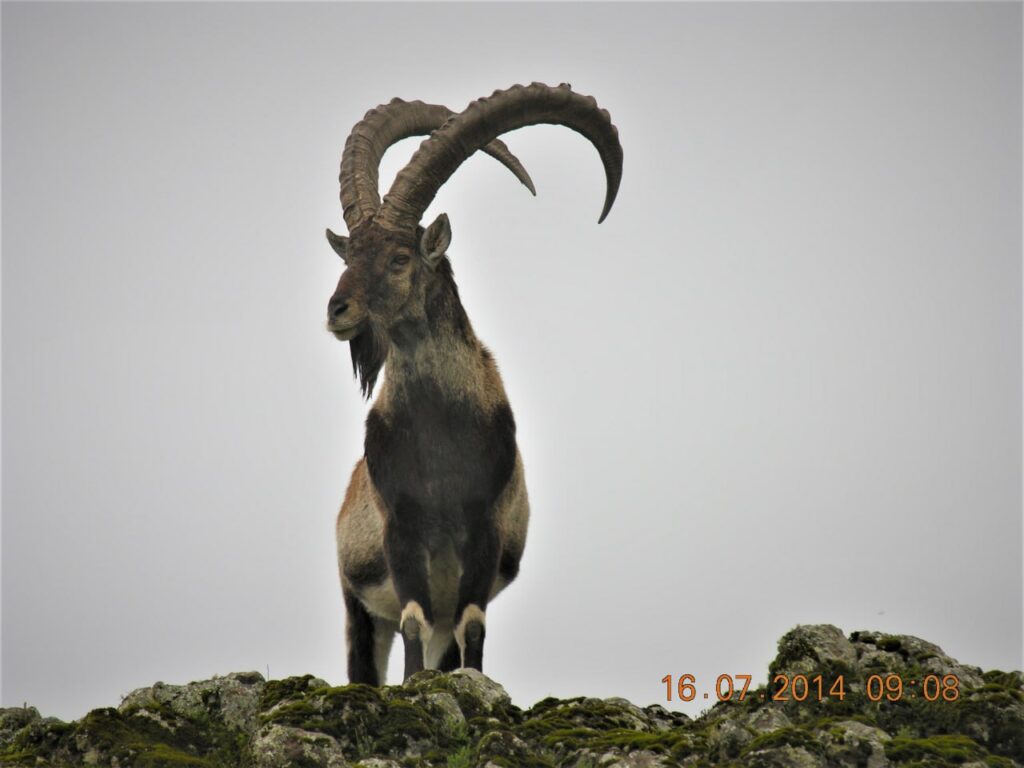
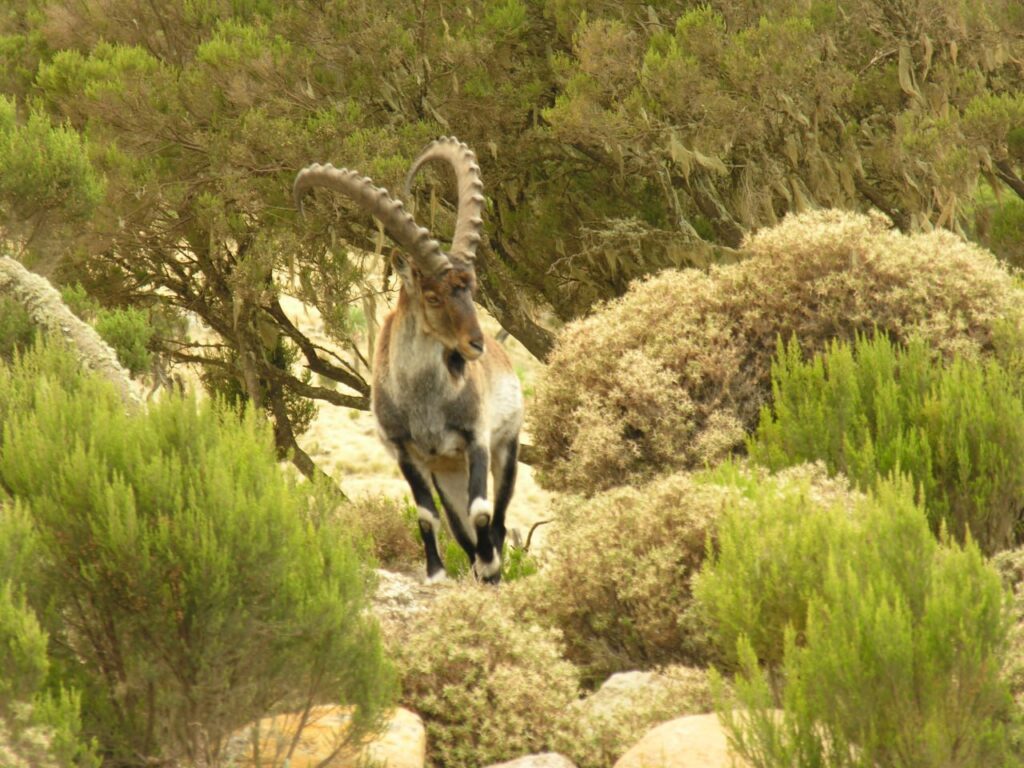
Walia Ibex (Capra ibex walie)
Local name: Walia
Local legend states that the walia came to the park with Saint Kidus Yared who used them to carry his holy books.
First formally recorded in 1835 by the explorer, Rupell, the walia ibex is found nowhere else in the world but the Simien Mountains National Park. Walia ibex live on the steep slopes and escarpments of the Simien Mountains between 2,300 and 4,000m; however, they are mostly found between 2,500 and 3,000m. Walias live in groups and forage in open areas. Male and females usually graze separately, unless mating.
Due to its restricted range and low population numbers, the walia ibex is listed as ‘Endangered’ on the IUCN Red List. Before the 1980s, walia ibex sightings were rare, however groups are now easily seen and they have expanded their range as human disturbance in some key areas has decreased.
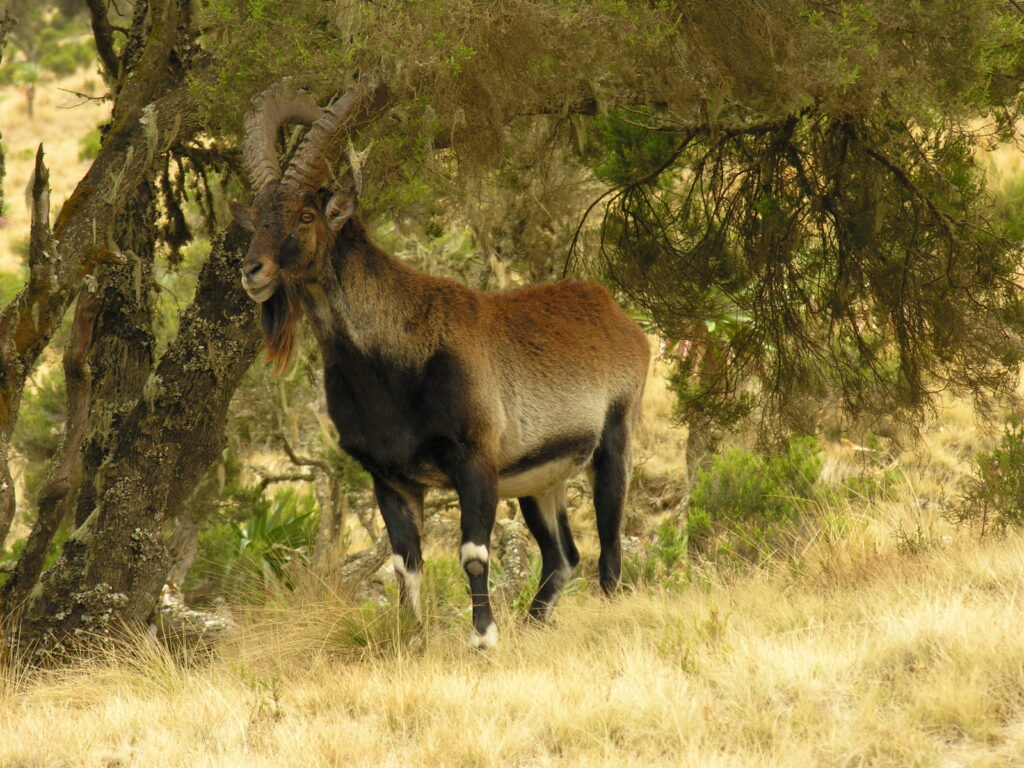
By: Lakew and Maru
The Walia Ibex (Capra walie), a rare and iconic species found only in Simien Mountains National Park, has experienced a remarkable journey of survival. When the park was first established in 1966, only 150–300 individuals remained. Thanks to conservation efforts, the population rebounded to 500 by 1983, though the impact of civil unrest led to a decline, leaving just 200 individuals by 1994.
However, with dedicated protection, the population once again surged to 500 by 2004, thriving in key areas such as Chennek and Bwahit, where visitors could easily spot these majestic animals. But recent surveys conducted in 2024/25 reveal a worrying decline, with the population dropping to just 306 individuals.
This alarming trend underscores the urgent need for stronger conservation measures to safeguard the Walia Ibex and its fragile habitat. Simien Mountains National Park remains committed to protecting this endangered species, ensuring that future generations can witness the beauty of this highland survivor.